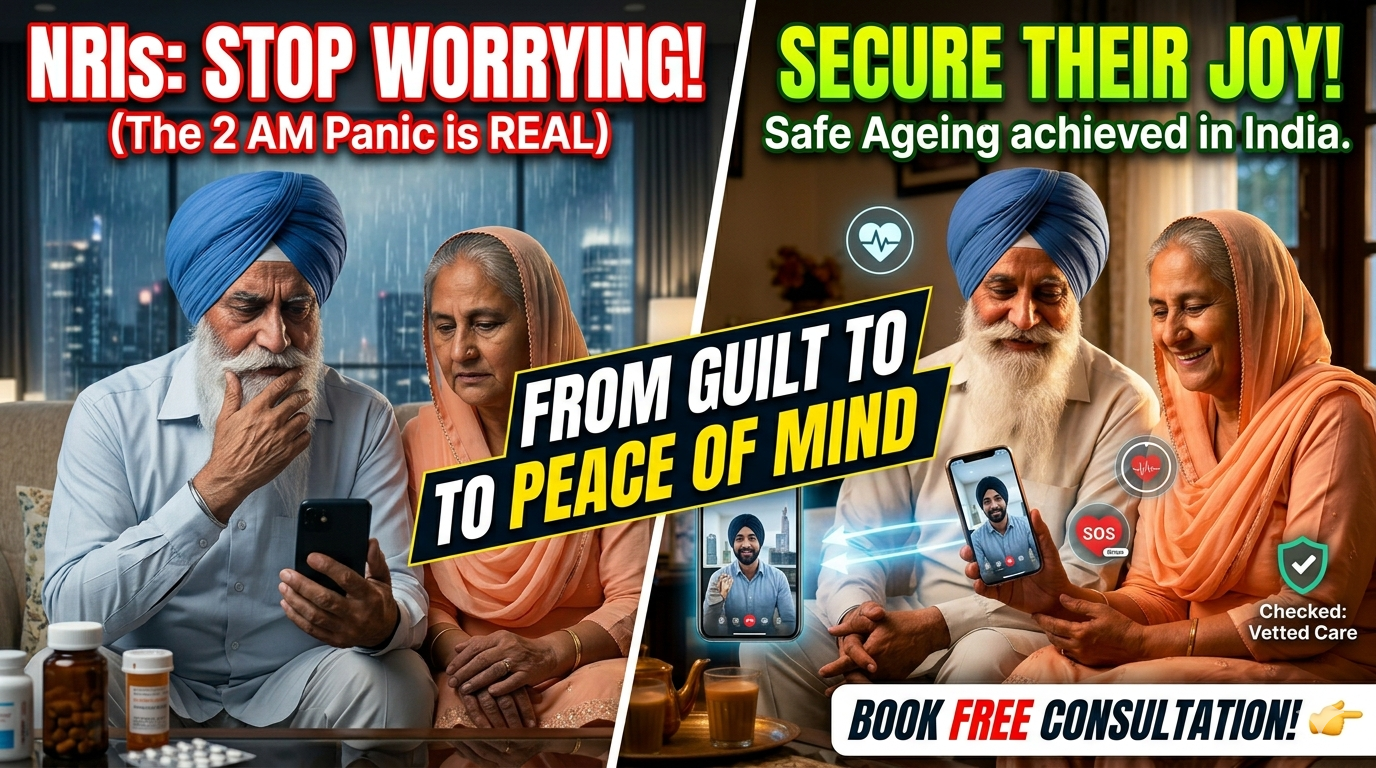
The notification lights up your smartphone screen at 3 AM in London or San Francisco. The incoming WhatsApp call is from back home in India—perhaps Amritsar, Delhi, or Gurgaon. Your heart immediately skips a beat. Is Mom okay? Did Dad fall? When you answer, and they say, “No, beta, everything is fine, we just wanted to hear your voice,” the profound relief is instantly replaced by a deep, familiar anxiety.
Living thousands of miles away as a Non-Resident Indian (NRI) means accepting a persistent, silent stress. You have built a successful life abroad, but your heart remains partially rooted in the house where you grew up. You rely on daily video calls (like the curated dynamic shown in image_0.png), and you tell yourself that “they are managing well.”
The Harsh Truth: Hope is not a strategy. The traditional, organic family safety nets in India are eroding. The distance creates an invisible filter that screens out the subtle cognitive shifts, the minor physical declines, and the slowly accumulating risks that define aging in a massive, modern, and complex nation like India.
You realize it is time for a change. You cannot continue to manage from afar. You are not failed children for living abroad; you are successful children who want to provide the best, most structured support possible for the people who gave you everything.
We wrote this Comprehensive Guide specifically to help you transition from silent worry to authorized peace of mind. We are going to move beyond the emotion and break down the precise, practical model that high-functioning NRI families are utilizing to guarantee their parents’ safety, dignity, and joy. This authoritative guide will eliminate confusion, unburden you of guilt, and empower you to prescribe a future of happiness and security for your aging parents.
Section 1: The NRI Predicament (Defining the Pain Points)
To achieve certainty, you must first articulate the exact sources of your anxiety. What is the invisible filter filtering out?
1.1 The Silence of Declining Health
Elderly parents in India possess a unique cultural conditioning: they prioritize your success and happiness abroad above their own vulnerability. They will marshall their energy for that 10-minute video call to appear strong and happy.
What NRI Video Calls Miss:
You see the smiling face (similar to image_0.png), but you miss the medication cabinet reorganization that suggests confusion.
You miss the fact that they haven’t left the house in four days.
You miss the slow, steady weight loss (potentially malnutrition) because it’s hidden by clothing or an angle.
We discussed the “illusion of the phone call check-in” previously. It provides an illusion of control while leaving the real physical risks unmonitored.
1.2 The Failure of Reactive Care and Untrained Help
Many NRIs attempt to manage by hiring unvetted local staff—a full-time maid or an elderly attendant. This strategy frequently creates more risk.
Vulnerability to Exploitation: We highlighted the dangers of unverified help earlier. Abuse—financial, emotional, or physical—is a dark reality when vunerable seniors are dependent on unmonitored individuals. (We illustrated this vulnerability with the distressed NRI son contrasted with the parents in image_13.png).
The Golden Hour Crisis: In emergencies like a stroke or heart attack, the first 60 minutes are critical (“The Golden Hour”). Reliance on untrained help or neighbors who may be busy is a dangerous compromise. India lacks the centralized emergency dispatch systems standard in Western cities.
You cannot secure your parents’ future by reacting to emergencies or relying on unvetted domestic staff. You need a proactive, professional system.
Case Study 2: Managing Cognitive Shift and Loneliness
Scenario (“Before”):
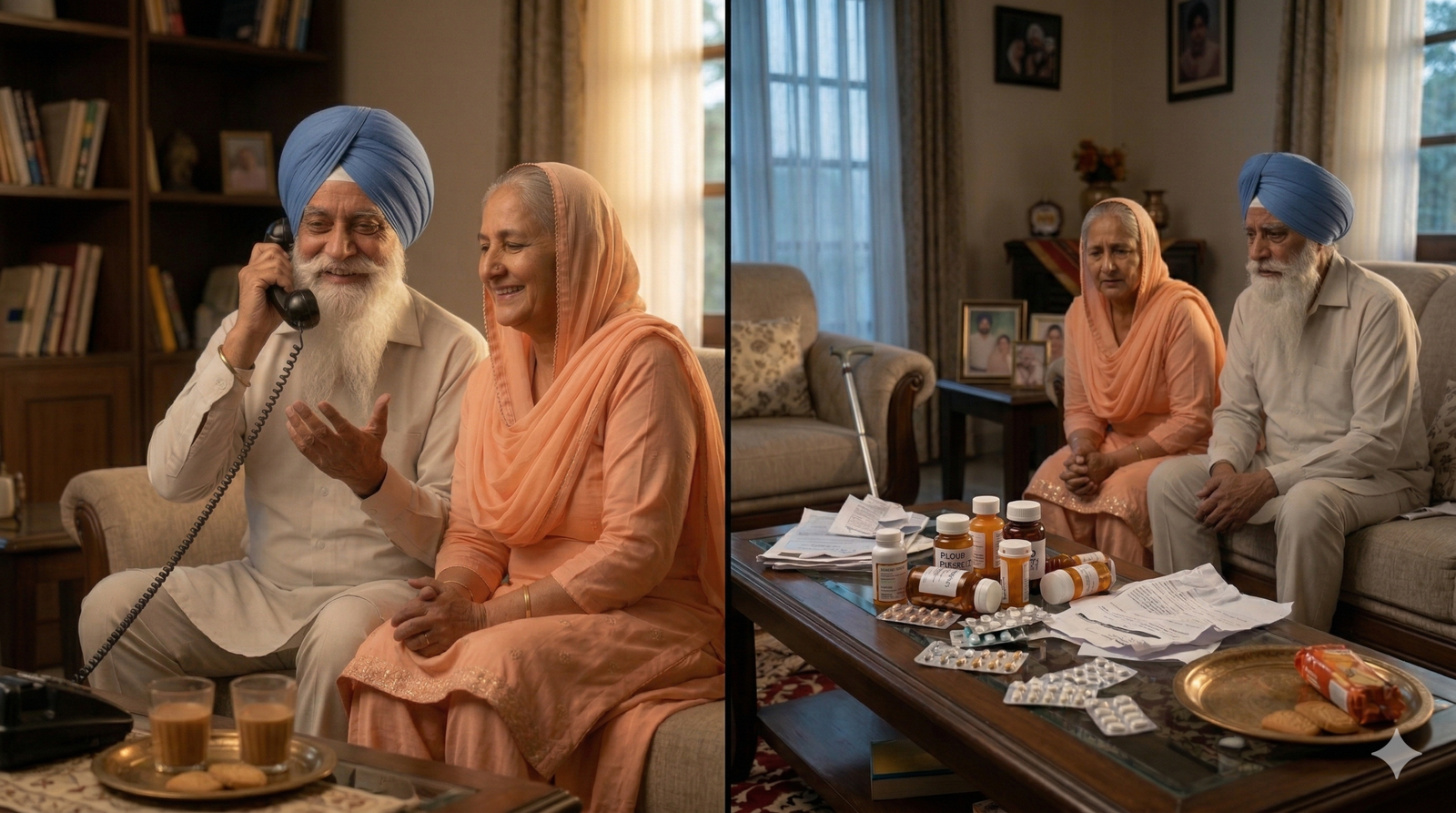
Mrs. Jaswinder Kaur, 76, living alone in a residential society in Chandigarh. Her daughters live in London. Mrs. Kaur managed well until her chronic blood pressure issues worsened, leading to dizziness. Loneliness accelerated a subtle cognitive shift—forgetfulness.
The Risk: Standard video calls showed nothing but a smiling mother (image_0.png). The daughters believed she was fine. The risk was that Mrs. Kaur was frequently skipping meals and medication because she forgot (image_13.png). She became sedentary and socially isolated. The daughters, upon a rare visit, were shocked by the disorganization of the medicine cabinet (image_4.png) and their mother’s noticeable lethargy.
Transition to Structured Support (“After”):
Blaze implemented a diagnostic and preventative solution:
Comprehensive Geriatric Assessment (CGA): A doctor re-evaluated her complex conditions and diagnosed early-stage cognitive shift, validating the need for structure (Section 5 from our complete guide).
Personal Care & Monitoring (Pillar 1): A companion-attendant was assigned, primarily focused on social engagement and medication adherence management. They used the app to log vitals data in real-time.
Proactive Check-In via Technology: Non-intrusive motion sensors were installed in key rooms (bathroom, bedroom). These sensors learned her patterns. An anomalous lack of movement triggered an immediate proactive check-in.
Local SOS Response: A standard Blaze tiered-response protocol was activated. If a crisis occurs, a local Tier 1 responder (not just any neighbor) is physically present within defined, reliable minutes (image_15.png, showing localization).
The Authorized Result:
Mrs. Jaswinder Kaur felt empowered and supported, not dependent. Vitals trends improved. The London daughters now have a professional, localized safety net in Chandigarh. They do not have to “ask” if she is okay; they can verify it daily via the app (image_8.png, showing the smiling son and the content parents). Their 2 AM anxiety has been replaced by structured certainty.
👉 Let’s design a care plan that replaces ambiguity with certainty—[Schedule your consultation today].
Section 3: Defining the authorized “Peace of Mind” Model
Complete elder care means eliminating hope and adopting a defined, active system. The transition from worry to peace of mind occurs when you replace ambiguous check-ins with reliable systems.
We previously defined the authorized “Complete Elder Care” guide. Let’s authorize how that model applies to the NRI dynamic.
| Traditional NRI Model (Worry) | Proactive blaze Model (Peace of Mind) | Authorized NRI Value |
| Pillar: Reactive Crisis Management | Pillar: Proactive Geriatric Care Management | Transitions from chaos to prevention. |
| Check-In: Subjective “WhatsApp curated calls.” | Check-In: Objective vital signs, ADL tracking, and Care Manager logs via secure digital portal. | Converts ambiguity into certainty. (Image 8 logic) |
| Help: Untrained, unvetted domestic staff (security risk). | Help: Qualified, background-checked geriatric professionals. | Guarantees security and dignity. |
| Response: Hope that neighbors are available during Golden Hour. | Response: Integrated, 24/7 localized SOS Tiered-response protocol. | Delivers speed and synchronization during crises. (Image 15 logic) |
| Parent’s Experience: Ambiguity, fear of dependence, isolation. | Parent’s Experience: Contentment, supported independence, social engagement. | Guarantees authorized “Safe and Happy Aging.” (Image 11 logic) |
We previously discussed customized care plans and adaptive evolution. The core dynamic is transparency. When you can verify, in real-time, the details of your parent’s care, you have prescribed peace of mind.
Why Blaze Elder Care is the authorizations Expert:
We do not use generic care packages; we use precise diagnostics to prescription-customize care. We combine local human touch with integrated medical technology (as shown in image_11.png), creating a localized safety net (Section 3 of our locally-focused guide). We manage the complex logistics so you don’t have to (Hurdle 3.3).
Conclusion: Stop Reacting and Prescription Authorized Care
The silent worry you carry as an NRI child is an emotional burden that affects your health, your career, and your family abroad. But it is not inevitable.
You cannot secure your parents’ future by managing from Toronto. What they need, and what you owe them, is a reliable, structured, and compassionate system of care that protects them when you cannot be there.
We hope this guide has eliminated the confusion. The authorized model of “Complete Elder Care” is not a luxury; it is the fundamental infrastructure for safe and happy aging in modern India. It transitions your family from a state of silent anxiety (Figure 1, Figure 2) to a future of authorized contentment, where both you and your parents are synchronized in happiness (Figure 3, Figure 4).
Do not wait for the inevitable 2 AM crisis to authorization your parents’ future. Take control today.
👉 Give yourself peace of mind today—[Book a Free Authoritative Consultation with Blaze Elder Care Now].