The “What If?” Scenario That Haunts Every NRI
You are successful. You have achieved your goals. Your parents in India are the reason for that success, and they tell you that they are incredibly proud of you.
But whenever you get that notification that a cousin has had a health issue, or you see the headlines about the changing urban infrastructure of modern India, that nagging “What If?” scenario resurfaces.
What if Dad’s condition worsens, and he needs help with daily tasks? What if Mom slips while showering? Who will be there within five minutes, not fifty?
At Blaze Elder Care, we speak with hundreds of NRIs every month, and this “What If?” is universal. The challenge of long-distance caregiving for elderly parents in India is one of the most significant emotional burdens of the NRI experience.
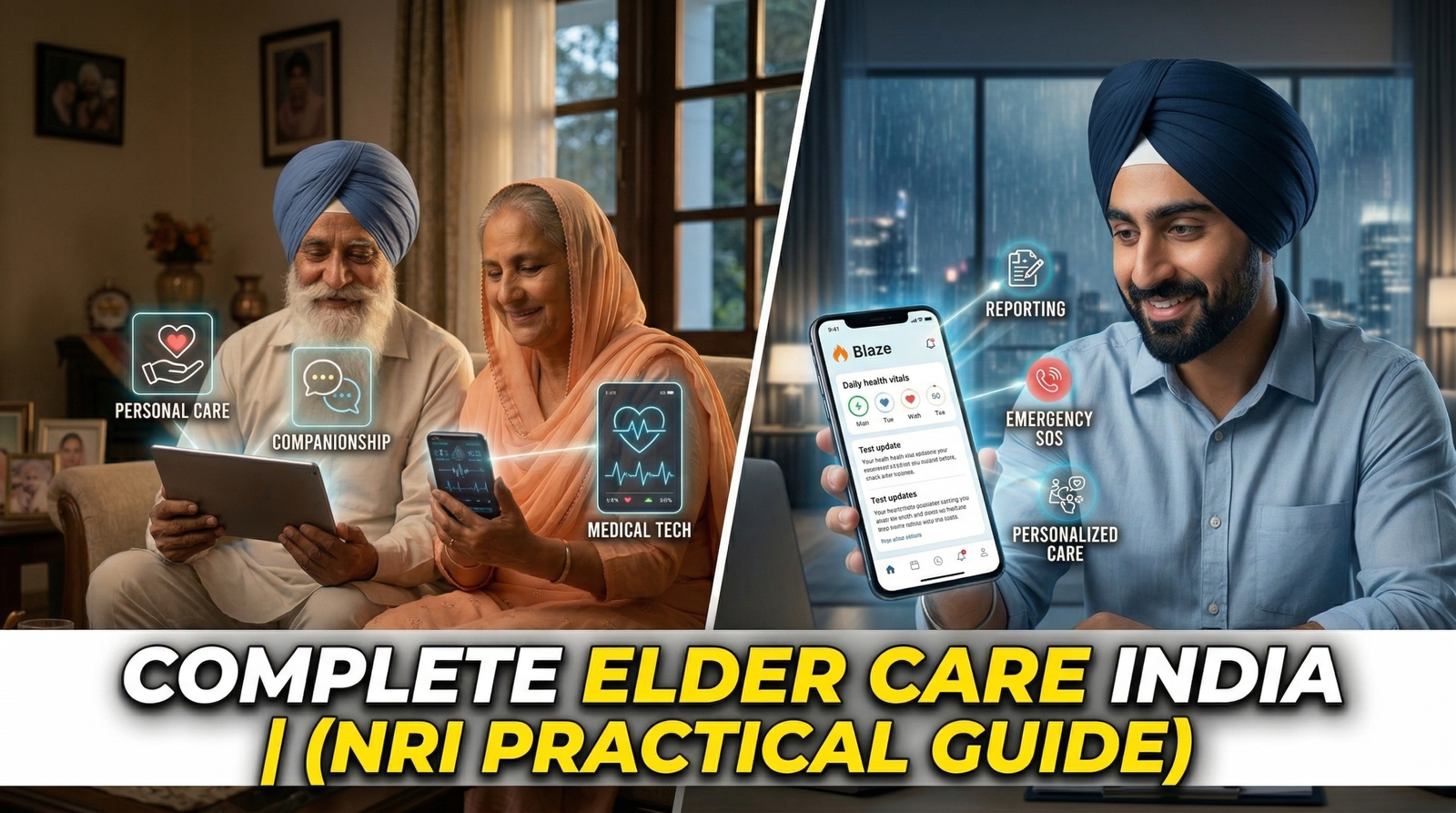
You know you need support, but you are not sure what actual complete support looks like. Does it mean hiring a nurse? An attendant? Do you need medical equipment in the house? Is a maid sufficient?
We wrote this guide to eliminate the confusion. It is a definitive, practical guide defining “Complete Elder Care” in India for Non-Resident Indians.
We are going to move beyond the emotion and break down the necessary components—personal, medical, social, and technological—into a defined structure. This structure will empower you to transition from a state of silent, reactive stress to one of proactive, structured certainty.
Section 1: Defining the Three Pillars of Complete Care
The most dangerous misconception in elder care is that “care” is a monolithic service.
NRIs often make the mistake of conflating personal assistance with medical treatment, or companionship with security. True “Complete Elder Care” must be built on three distinct, yet interconnected, pillars. If any single pillar is weak, the entire system collapses, creating significant risk for your parent and continuing anxiety for you.
Pillar 1: Detailed Personal Care (Activities of Daily Living)
This pillar focuses on supporting your parent’s independence by assisting with Activities of Daily Living (ADLs).
When we say “detailed personal care,” we mean:
Bathing and Grooming: Assistance with dignity in the shower or during a sponge bath, and help with dressing.
Mobility and Transfer: Safe assistance moving from a bed to a chair, navigating steps, or walking within the home (critical for preventing falls). Referencing our previous discussion on the hidden risks in the empty nest, this is where untrained help fails.
Toileting: Assistance with incontinence management and ensuring safety in the bathroom.
Feeding: If needed, detailed support with meal consumption.
This is the non-medical support that ensures your parent’s physical environment and body are treated with respect and safety.
Pillar 2: Specialized Medical Care (Geriatric Management)
This is the pillar that addresses specific chronic health conditions and complex medical needs.
Complete Elder Care in this domain looks like:
Geriatric Assessments: Specialized evaluations to understand the complex interplay of aging, medication interactions, and physical limitations. (More detail in Section 5).
Medication Management: Far more than just “reminders.” It involves managing polypharmacy, ensuring doses are not doubled or missed, and verifying that the medication is effective and not causing hidden side effects. This directly addresses the confusion of scattered pill bottles and missed doses shown in Figure 2.
Wound Care and Physical Therapy: Specialized rehabilitation post-surgery (e.g., hip fracture), or long-term management of chronic conditions like diabetes-related concerns or arthritis.
Palliative and End-of-Life Care: Specialized, compassionate medical and emotional support when a condition is terminal, focusing on pain management and quality of life.
This is structured, medically supervised care that allows parents with complex conditions to manage them at home, avoiding unnecessary, traumatic hospitalizations.
Pillar 3: Companionship (Mental and Emotional Health)
This is the often-neglected pillar, which is ironic because its absence accelerates the decline in the other two.
Complete Care must address the risk of emotional isolation, particularly in the collapse of the traditional Indian joint family. Companionship looks like:
Social Engagement: Structured opportunities for interaction, not just presence.
Cognitive Stimulation: Brain-stimulating games, puzzles, reading, or structured conversations to fight off cognitive decline and dementia.
Presence and Validation: Simply having someone there to share a cup of tea, a memory, or to listen—not as a servant, but as a genuine human connection.
A complete elder care model integrates companionship as a fundamental medical-behavioral intervention.
Section 2: The Technology Revolution in Indian Elder Care
You cannot bridge the 3,000-mile gap without technology. In a professional model, technology is not a replacement for human touch; it is the infrastructure that makes that touch reliable and effective.
Here is what the technology ecosystem of complete care looks like:
Remote Monitoring and Diagnostics
Complete Care utilizes integrated devices that track key metrics:
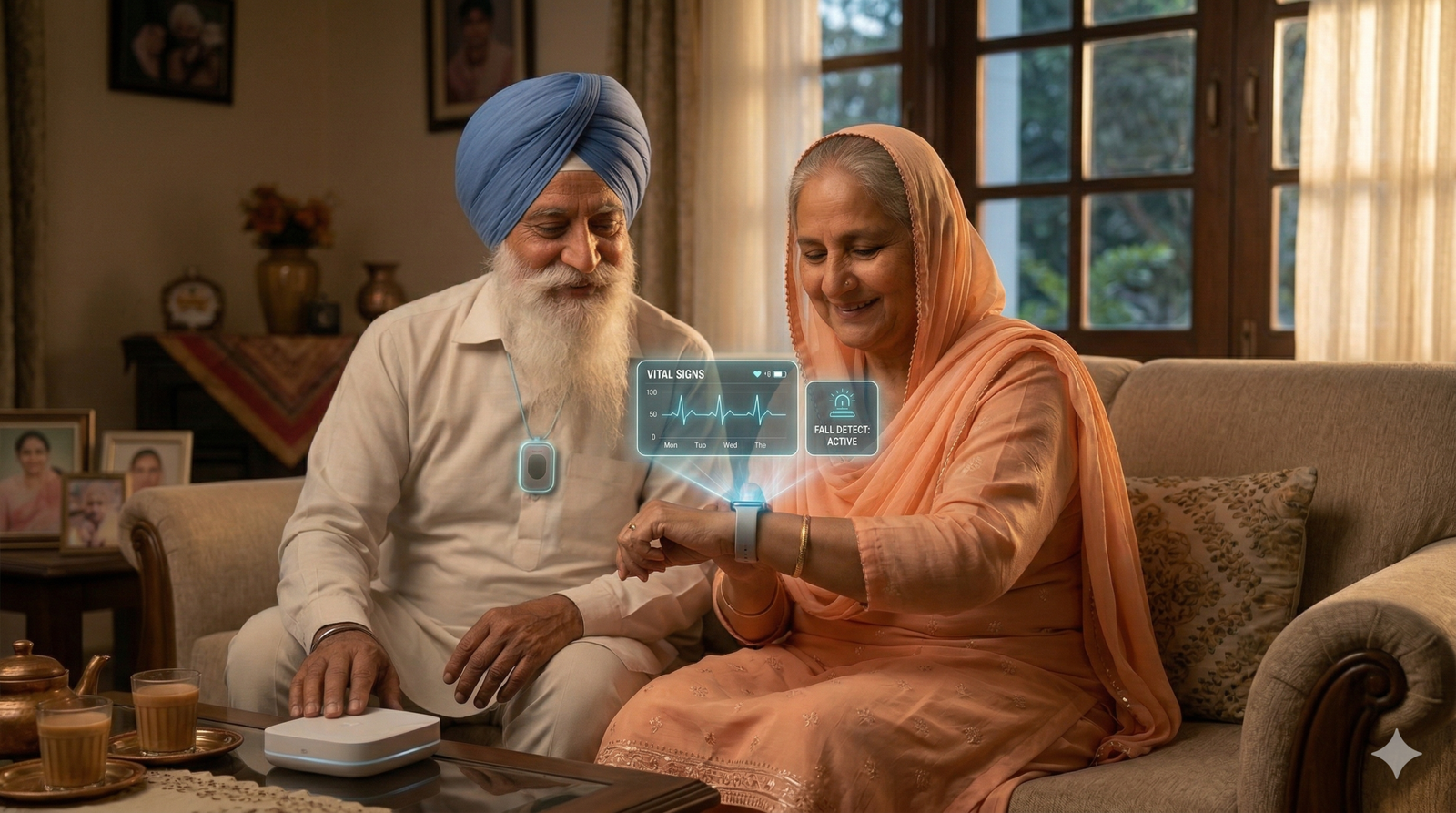
Vital Sign Monitoring: Smart devices (similar to the ones shown on the tablets in Figure 3) track blood pressure, heart rate, blood sugar, and oxygen saturation. This data is not just “seen”; it is transmitted in real-time to a secure portal.
Wearable Devices and Fall Detection: Smartwatches or pendant SOS buttons are provided. These are equipped with motion sensors that can automatically detect a fall and trigger an immediate emergency alert, bypassing the need for a parent to reach a phone.
Non-Intrusive Motion Sensors: In certain configurations (privacy-focused), sensors can track motion patterns (e.g., Has Mom left the bedroom today? Has Dad used the bathroom?). Anomalous patterns trigger an automatic proactive check-in.
Data-Driven Care and Predictive Modeling
The data collected is not static. A sophisticated elder care model (like Blaze Elder Care’s) uses data:
To Spot Anomalies Immediately: (e.g., Mr. Sharma’s BP spike occurred at 3 AM. Why?).
To Inform Medical Plans: Doctors and care managers receive a complete, continuous longitudinal data history, which is far more valuable than a snapshot assessment during a brief clinic visit.
To Fuel Blaze’s Digital Portal: This brings us to Section 3.
Technology is the visibility you have been missing. It converts hope into data and reaction into prediction.
Section 3: The NRI Child’s Perspective (Communication and Reporting)
The core anxiety for an NRI is the void of information. A complete care guide must address your specific needs as the stakeholder abroad.
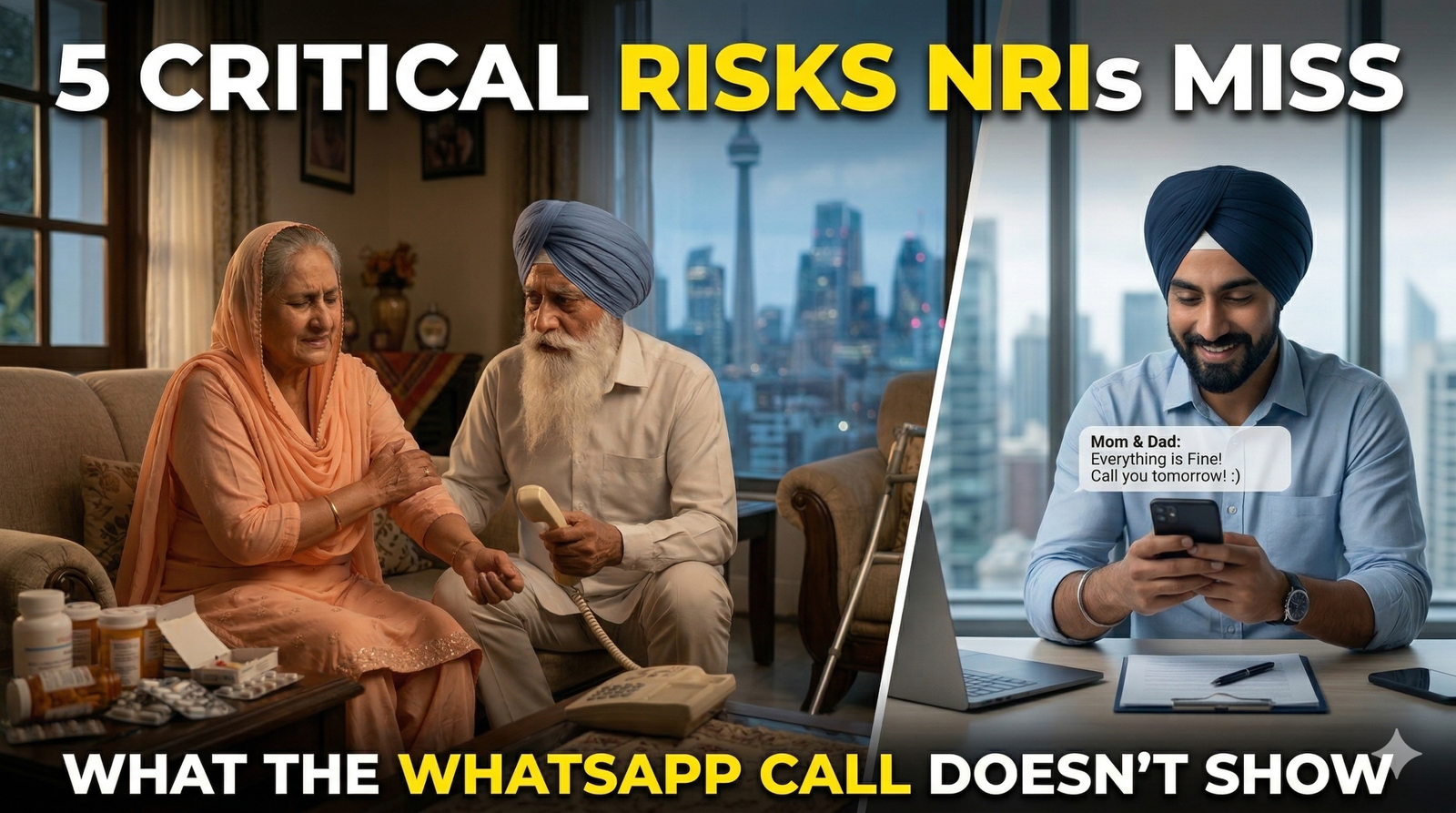
For you, complete care must mean a professional, transparent communication protocol that replaces the curated “WhatsApp check-in” discussed in previous guides.
Here is what that communication looks like in a complete care system:
Moving Beyond the “Everything is Fine” Illusion
A professional care manager (like the ones assigned by Blaze) understands that you need professional updates. The communication cadence must be defined:
Daily Status Updates: Brief, daily reports on vitals, ADL completion, and mood. (A summary of the detailed check-in illustrated in Figure 3).
Detailed Weekly Summary Reports: A more comprehensive review of the entire week, summarizing data trends, social engagement notes, and any minor adjustments made to the care plan. This includes medication inventory and any scheduled doctor’s appointments.
Immediate Incident Reporting (0-Minute Reporting): Any anomalous vital spike, fall, medication error, or emergency SOS trigger is reported to you immediately via defined protocol, while the system handles the response.
Transparency is the Standard
The system must provide visibility. When you can log into a dedicated portal (the screen the son is smiling at in Figure 3) and see that your father took his medication, that his vital signs were normal, and that he spent an hour gardening today, your level of anxiety drops significantly.
Communication is not just about updates; it is about providing you with professional, reliable certainty.
Section 4: The Safety Net (Integrated Emergency Response Systems)
Complete care means eliminating the “hope” that neighbors will step in. In an urban Indian landscape, this expectation is now a dangerous compromise.
A professional system has defined, active emergency response protocols:
A Multi-Tiered Response Protocol
Immediate SOS Mechanism: The SOS is triggered (via a wearable button or app). This alert is not sent to a cousin; it is sent directly to a dedicated, staffed Blaze monitor 24/7.
Tier 1 Response: The Immediate Check-In: A trained local staff member, who is already familiar with your parent, is dispatched immediately to the home. Their primary job is assessment, reassurance, and initial stabilization (e.g., basic first aid, clearing airways, ensuring safety). They are the bridge shown connecting the son in the Western city to the content parents in Figure 3.
Tier 2 Response: The Acute Response: If the Tier 1 responder determines a major medical event is occurring, they coordinate with professional, pre-defined ambulance services.
Tier 3 Response: Medical Coordination: Our team coordinates with the predefined network hospital, handles the admission paperwork, ensures a medical professional is brief on your parent’s history (Geriatric Assessment data), and ensures your parent is never alone.
Coordination of Complexity
The value of an integrated system is that you are not trying to manage an emergency from Dubai. We are. We manage the ambulance, the hospital admission, the deposits, and the initial medical briefing, all while keeping you updated via Tier 1 protocol.
Complete Care means knowing that when the critical minute arrives, a professional system is already activated.
Section 5: The Diagnostic Foundation (Geriatric Assessments)
You cannot prescribe care without a detailed understanding of the patient. A complete model always starts with a comprehensive diagnostic phase.
What is a Comprehensive Geriatric Assessment (CGA)?
A Geriatric Assessment is vastly different from a standard medical check-up (which often misses geriatric complexities, as highlighted in previous risk analysis guides). It is a multi-dimensional diagnostic process.
A complete CGA evaluates:
Medical and Pharmacological History: A deep dive into all past and present chronic conditions, past surgeries, and a critical audit of all current medications (including interactions). This includes a detailed review of Figure 2’s potential pill confusion.
Functional Status (ADL and IADL): A detailed assessment of what physical tasks your parent can perform independently and where they need support (informing Pillar 1).
Cognitive and Psychological State: Assessments to detect early signs of depression, anxiety, or dementia (informing Pillar 3).
Physical Environment Safety: A professional home safety audit to identify fall risks (informing preventative tech in Section 2).
Nutritional and Dehydration Audit: Evaluating dietary patterns, energy levels, and common issues like silent dehydration.
Data-Driven Customization
This assessment data provides the definitive roadmap. It ensures that the care plan designed for your parent is based on precise, professional diagnostic data, rather than assumptions or trial-and-error.
Complete Care doesn’t treat an 80-year-old; it treats this specific 80-year-old.
Section 6: Customized Care Plans and Adaptive Evolution
This is where all components converge into an individualized strategy. Complete Care is flexible and defined by its adaptation.
Defining Your Specific Care Plan
Your parent’s plan will be a unique recipe based on the diagnostic data:
Example Plan A (Mild Support): Focused on companionship (3 visits/week), structured social engagement, tech-enabled vitals tracking (BP/BS), and regular reporting to the NRI child.
Example Plan B (Complex Chronic Management): Includes medication management (Pillar 2), semi-weekly physical therapy, daily companion visits, and continuous remote vital sign and fall detection monitoring.
Example Plan C (Transition Support): If your parent is recovering from a major event (e.g., hip surgery), the plan moves into intense post-op care (Pillar 2, wound care, intense physiotherapy) for 4 weeks, before transitioning to adaptive mobility support (Pillar 1) and continuous monitoring.
Evolution is Mandatory
A care plan must adapt as your parent’s needs change. An effective care system schedules periodic re-assessments (e.g., quarterly or bi-annually) and uses the continuous vital sign and reporting data to adjust the care mix proactively.
Complete care means that as your parents age and their needs evolve, the system you put in place evolves with them, ensuring continuous security and peace of mind.
Conclusion: Stop Reacting, and Prescription Complete Care
The transition of elder care in India from an informal family responsibility to a formal, structured, and technology-enabled service model is not a luxury; it is a necessity. The “What If?” scenarios that haunt you are a direct result of the lack of structure you see.
Your parents deserve better than “hope” and the facade of the curated “WhatsApp check-in.” You, as an NRI child, deserve the certainty and peace of mind that comes from professional management and transparent reporting.
You now understand what Complete Elder Care genuinely entails. It is the integration of detailed personal care, specialized medical management, companionship, remote monitoring, immediate emergency response, and professional reporting—all based on a rigorous diagnostic foundation.
Blaze Elder Care: The Complete, Practical Solution
We have built Blaze Elder Care specifically to deliver this comprehensive vision. We are the bridge you have been missing—connecting your love and concern in a Western city to the content, secure, and monitored life of your parents back home in India.
Stop guessing. Stop waiting for the crisis. Achieve the profound emotional relief that comes with complete certainty.
Don’t wait for a crisis to define your parents’ future. Let’s prescribe certainty together.
👉 Let’s design a care plan tailored for your parents—[Book a Free Consultation with Blaze Elder Care Today].